How to tell real, quality matcha from fake (the authentication guide)
You can judge most of a matcha's quality and authenticity with three senses plus a label scan — what we call the 3S: Sight, Smell, Sip. You can catch most low-grade, stale or mislabeled matcha before you ever buy it.
Last updated 2026-06-24 · prices noted "as of June 2026" and volatile — verify current before buying.
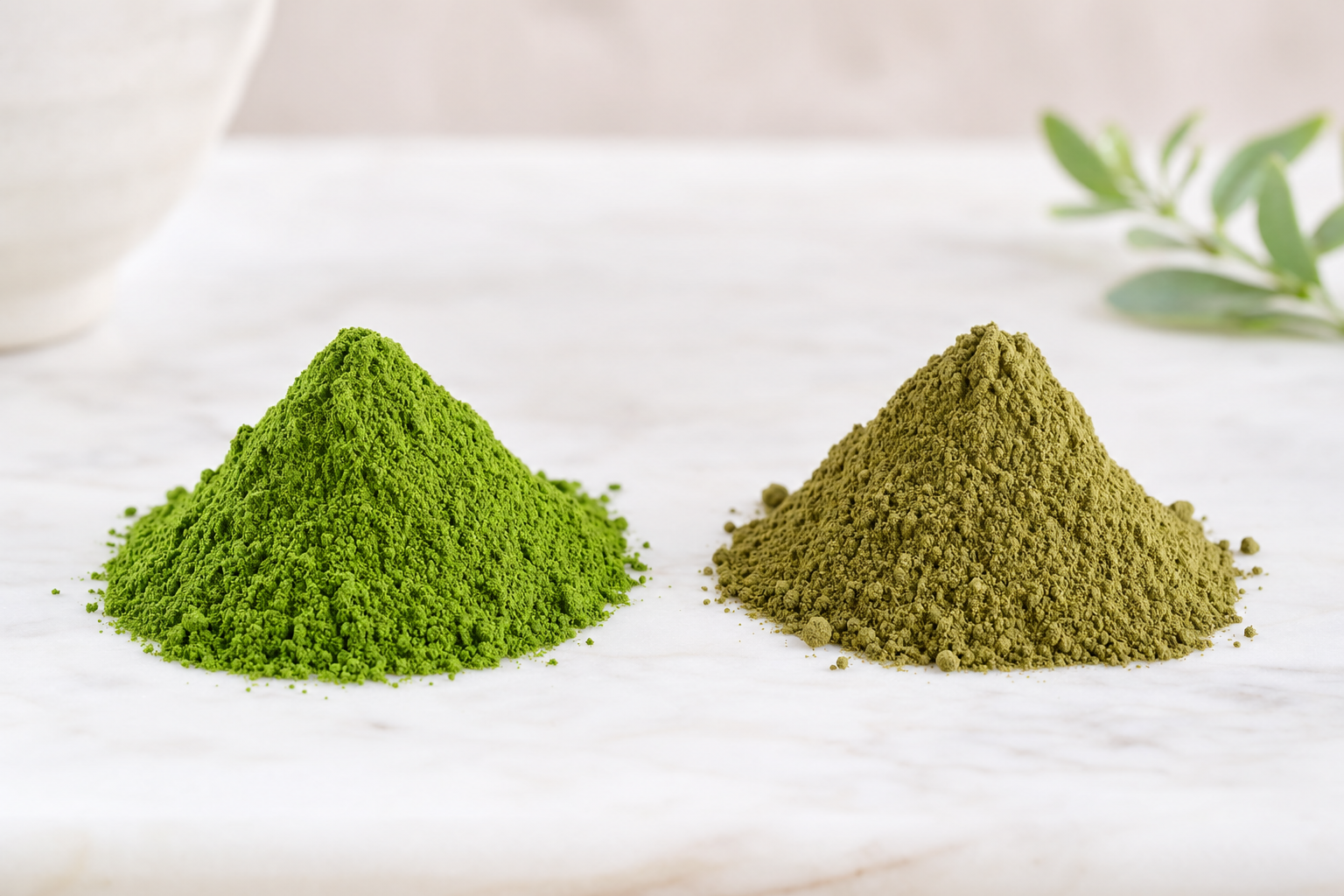
The 3S: Sight, Smell, Sip
The fastest field test. None of these alone is proof — read them together, then scan the label.
| Sense | What to look for | Status |
|---|---|---|
| Sight | Vivid jade green and an ultra-fine, silky powder. Dull, yellowish or brown = lower grade or old; neon/fluorescent = investigate for dye. | Reported Minimalist Baker — best matcha blind-taste review ↗ |
| Smell | Fresh, sweet and grassy with a marine/umami note — not stale, hay-like or musty. | Reported The Kitchn — best matcha taste test ↗ |
| Sip | Smooth umami and natural sweetness with manageable, pleasant bitterness — not harsh, flat or sandy on the tongue. | Reported The Kitchn — best matcha taste test ↗ |
The full authentication checklist
- COLOR — a vivid, jade-green powder is the good sign. Dull yellow, khaki, olive or brown means low grade, oxidation or age. Reported Minimalist Baker — best matcha blind-taste review ↗
- TOO-BRIGHT / FLUORESCENT GREEN — an unnaturally electric, neon green can indicate added dye. Treat it as a flag to investigate, not proof of fakery. Reported Tamara Rubin — independent third-party heavy-metal matcha testing ↗
- INGREDIENTS — the label should read '100% matcha' (or '100% green tea / tencha') with no added sugar, fillers, milk powder or generic 'green tea' dust. Reported The Kitchn — best matcha taste test ↗
- ORIGIN — look for Japan plus a named region (Uji, Nishio, Yame, Kagoshima). 'Product of Japan' with no region is weaker; non-Japan origin for true matcha is a red flag. Reported Perfect Daily Grind — matcha shortage & Japan production ↗
- HARVEST / FRESHNESS — a missing harvest or best-by date is a red flag. The best brands print a harvest date or a mill/packing date. Reported The Kitchn — best matcha taste test ↗
- CERTIFICATION — a real JAS (Japan) or USDA organic seal is verifiable. The US and Japan recognize each other's organic standards. USDA — US–Japan Organic Equivalence (JAS) FAQ ↗
- PRICE FLOOR — a common rule of thumb is roughly $1+ per gram for genuine ceremonial-quality matcha; suspiciously cheap 'ceremonial' is usually a relabel. (A rule of thumb, not a guarantee.) Reported Perfect Daily Grind — matcha shortage & Japan production ↗
- TEXTURE — quality matcha feels silky and fine between the fingers, not gritty or sandy. Reported The Kitchn — best matcha taste test ↗
- AROMA & TASTE — fresh, sweet, vegetal and umami, not hay-like, stale, flat or harshly bitter. Reported The Kitchn — best matcha taste test ↗
The label scan, in one line
Authentication FAQ
How can I tell if matcha is real or fake?
Use the 3S plus a label scan. Sight: vivid jade green and an ultra-fine, silky powder (dull yellow/khaki/brown means old or low grade; an unnaturally neon green is worth investigating for dye). Smell: fresh, sweet and grassy, not hay-like or musty. Sip: smooth umami and natural sweetness, not harsh or sandy. Then read the label — it should say 100% matcha with no fillers, show Japan plus a named region (Uji, Nishio, Yame, Kagoshima), and ideally a harvest or mill date. Suspiciously cheap 'ceremonial' is usually a relabel.
Is matcha dyed green?
Some low-grade or counterfeit matcha is reportedly colored with additives such as copper-chlorophyllin (E141) to fake a vivid green. This is plausible and reported — NOT proven to be widespread. Don't assume your matcha is dyed; treat an unnaturally fluorescent green as one flag to investigate among many, not proof.
What color should good matcha be?
A vibrant, jade green. Dull yellow, khaki, olive or brown suggests a lower grade, oxidation, or age. An unnaturally bright neon green can be a flag to investigate for added dye. Color shifts with lighting and screens, so use it alongside smell, taste, texture and the label.
Does a missing harvest date matter?
It's a yellow flag. The best brands print a harvest date or a mill/packing date, because freshness is everything with matcha. A complete lack of any date — harvest, mill, or best-by — makes it harder to judge freshness.
Is expensive matcha always better?
No — but suspiciously cheap 'ceremonial' is a red flag, since the term is unregulated. A common rule of thumb is roughly $1+ per gram for genuine ceremonial-quality matcha. Price is one signal among many, not a guarantee.
Is cheap matcha bad? → · Why "grades" are marketing → · Which brands to buy → · Is it safe? →